
Intellectual Thought and Methodology
Survivor-Centred Justice:
The Foundation of Our Approach
The intellectual foundation of our work is grounded in international human rights law, international criminal law, and the interdisciplinary field of transitional justice. It draws on critical and comparative scholarship that interrogates how justice is conceptualised, operationalised, and experienced in contexts of mass violence and structural inequality. Within this framework, we adopt a survivor-centred approach that both reflects and advances contemporary debates on accountability, participation, and the legitimacy of justice processes across international, domestic, and community levels.
At the heart of transitional justice and international criminal law lies a simple but often unmet principle: those most affected by harm must be central to the processes that seek to address it.
Survivors are not passive recipients of justice. They are knowledge holders, agents of change, and essential contributors to truth-seeking, accountability, and healing. Their lived experiences provide insights that no external expert, however well-intentioned, can replicate. Without their meaningful participation, justice risks becoming procedural rather than transformative.
This is equally true at the regional and global level. African voices, legal scholars, practitioners, communities, and institutions must not be positioned at the margins of international justice, but at its core. Africa has been a site of significant engagement by international justice, yet too often the frameworks, priorities, and narratives have been shaped externally.
There is a growing recognition that, while often well-intentioned, parts of the global human rights ecosystem continue to operate through structures in which agendas, funding, and knowledge production are largely shaped outside the regions most affected. In this context, the experiences of communities particularly in Africa can become central to the work of the field, without always being matched by equal levels of authorship, leadership, or long-term benefit. Addressing this imbalance is essential to ensuring the credibility and sustainability of justice efforts.
Pursue Peace is grounded in the belief that sustainable and legitimate justice requires a rebalancing of this dynamic.
Beyond Extraction: Towards Ethical Engagement.
There is a growing recognition that parts of the human rights and international justice ecosystem risk reproducing extractive practices. Local experiences, testimonies, and contexts are sometimes treated as inputs into externally driven agendas—informing reports, securing funding, or advancing institutional mandates—without equitable ownership, representation, or long-term benefit for those communities.
This is not always intentional, but its effects are real.
For justice to be credible, engagement must move beyond short-term consultation or symbolic inclusion. It requires:
Genuine partnership with local actors
Fair recognition of intellectual and experiential contributions
Investment in local capacity and leadership
Accountability to the communities whose experiences underpin the work
Survivor-Centred Justice
Survivor-centred justice, constitutes a critical reorientation within international human rights law, international criminal law, and transitional justice. It reflects a normative and methodological shift away from predominantly state-centric and perpetrator-focused models of accountability towards frameworks that place survivors at the centre of justice processes, both conceptually and operationally.
At its core, survivor-centred justice is grounded in established international legal principles, including the rights to justice, truth, and reparations. However, a persistent disjuncture remains between the formal recognition of these rights and their practical realisation. Existing justice mechanisms, particularly within international criminal law have been critiqued for their limited capacity to accommodate the diverse needs, experiences, and expectations of survivors, often reducing their role to that of witnesses within adversarial legal processes.
The conceptual contribution of survivor-centred justice lies in its insistence on recognising survivors as rights-bearing agents whose participation is integral to the legitimacy and effectiveness of justice processes. This entails moving beyond symbolic inclusion towards meaningful engagement, where survivors are able to influence both the substance and form of justice mechanisms. In this regard, the distinction between ‘victim’ and ‘survivor’ reflects broader questions of agency, identity, and empowerment within justice discourse.
Methodologically, survivor-centred justice adopts a pluralistic and multi-layered approach to accountability. While acknowledging the continued importance of retributive justice, it challenges the sufficiency of such approaches when applied in isolation. It therefore integrates restorative and community-based mechanisms, including traditional and customary practices, which can provide more accessible, participatory, and culturally resonant pathways for addressing harm, facilitating healing, and rebuilding trust.
Operationalising Survivor-Centred Justice
Operationalising survivor-centred justice requires translating normative principles into concrete institutional practices, processes, and safeguards across diverse contexts. Effective implementation depends on the extent to which systems are designed to meaningfully incorporate survivor perspectives and respond to the complexity of harm experienced.
This includes embedding survivor participation across the lifecycle of justice processes from design and policy development to implementation and evaluation. Participation must enable survivors to influence decision-making in ways that are safe, informed, and contextually appropriate, while recognising diversity in experience shaped by gender, age, disability, and socio-economic position.
A survivor-centred approach further requires strengthening coordination across fragmented systems. Justice processes intersect with health, psychosocial, and social protection systems, particularly in cases involving sexual and gender-based violence. Operationalisation therefore demands integrated responses that address immediate needs while supporting long-term recovery.
Safeguarding remains central. This includes adherence to do-no-harm principles, informed consent, confidentiality, and protection against retaliation or re-traumatisation. Institutional capacity must also be strengthened through training, oversight, and accountability mechanisms that ensure both legal compliance and ethical practice.
Finally, implementation must remain context-sensitive. In many settings, particularly in Africa, community-based and customary mechanisms play a critical role. When aligned with human rights standards, these mechanisms can enhance accessibility, legitimacy, and local ownership.
Together, these elements position survivor-centred justice as both an intellectual framework and a practical methodology capable of advancing accountability, restoring dignity, and contributing to sustainable peace.

An African Rooted, Survivor-Centred Approach
Pursue Peace advocates for a model of justice that is both survivor-centred and African-rooted, while remaining globally engaged.
This means:
Recognising survivors as co-creators of justice processes
Valuing African legal traditions, including restorative and community-based approaches
Aligning with frameworks such as the African Union Transitional Justice Policy (AUTJP)
Bridging local knowledge systems with international legal standards in a respectful and balanced way
The goal is not to reject international justice, but to strengthen it by ensuring it reflects the realities, priorities, and dignity of those it is meant to serve.
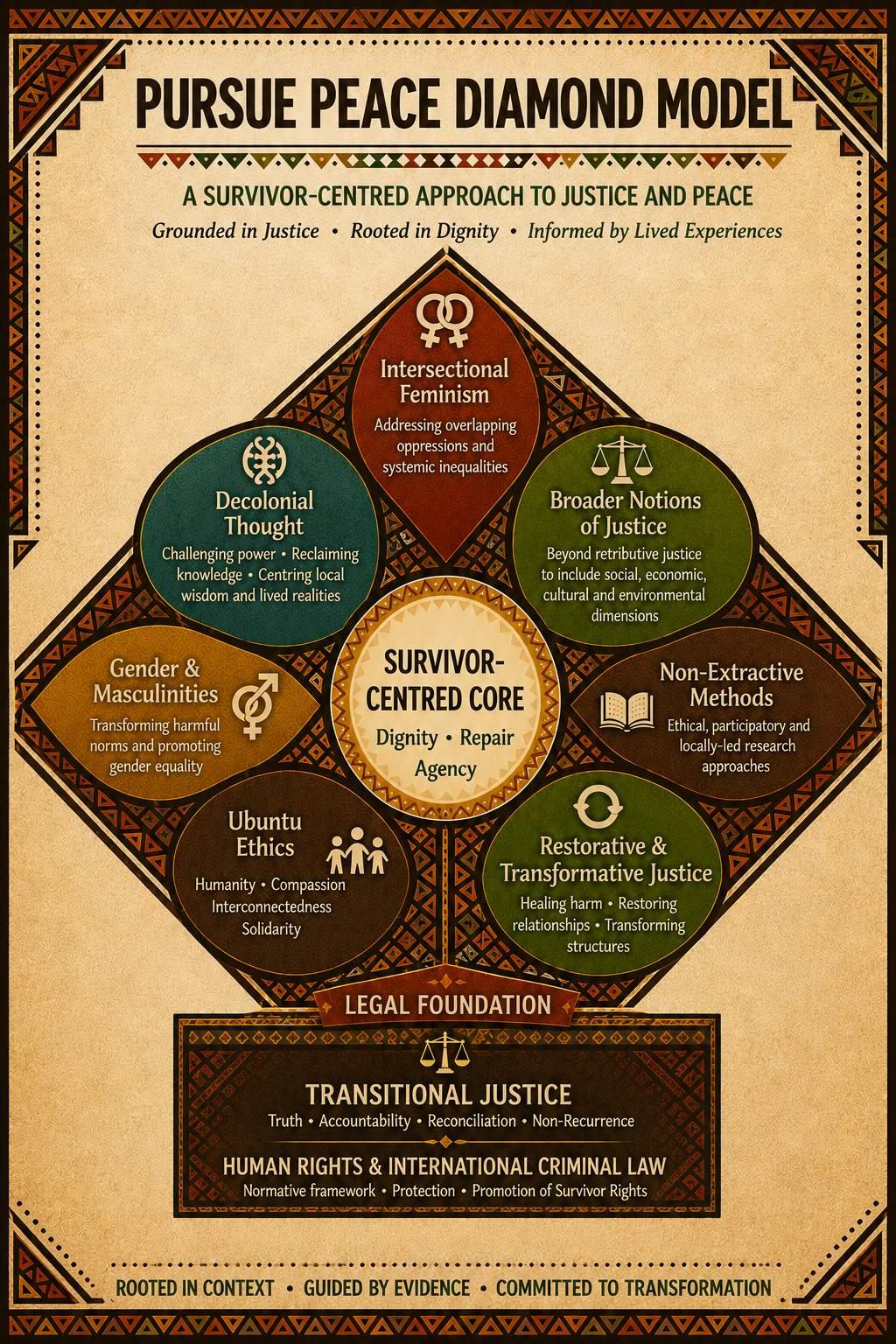
Our approach can be best articulated through the Pursue Peace Diamond Model. At its core lies survivor-centred justice, grounded in dignity, agency, and repair. This core is shaped by interrelated methodological lenses, including decolonial thought, intersectional feminism, gender and masculinities, ubuntu ethics, broader notions of justice, and non-extractive methods, alongside restorative and transformative approaches. Together, these methods guide how we understand harm, engage with survivors, and design justice processes that are inclusive, context-responsive, and capable of supporting meaningful accountability and long-term peace.